How to Upload a Sony Memory Stick Duo How to Upload Photos From Sony Memory Stick Pro Duo to My Asus
 | |
 From pinnacle to bottom: Memory Stick PRO, Memory Stick PRO Duo, Memory Stick Micro (M2) | |
| Media type | Flash memory card |
|---|---|
| Chapters | 128 MB (Original) 32 GB (PRO series) two TB (Xc serial) |
| Developedpast | Sony |
| Extendedto | Retentivity Stick PRO, Memory Stick Duo, Memory Stick PRO Duo, Retentiveness Stick PRO-HG Duo, and Retentivity Stick Micro |
The Memory Stick is a removable wink memory carte format, originally launched past Sony in late 1998.[1] In addition to the original Memory Stick, this family includes the Memory Stick PRO, a revision that allows greater maximum storage capacity and faster file transfer speeds; Memory Stick Duo, a small-grade-factor version of the Memory Stick (including the PRO Duo); the even smaller Memory Stick Micro (M2), and the Retention Stick PRO-HG, a high speed variant of the PRO to be used in high-definition video and still cameras.
As a proprietary format, Sony exclusively used Retentiveness Stick on its products in the 2000s such every bit Cyber-shot digital cameras, Handycam digital camcorders, WEGA and Bravia TV sets, VAIO PCs, early on Walkman digital sound players, and the PlayStation Portable handheld game console,[2] with the format being licensed to a few other companies early in its lifetime. With increasing popularity of SD card, in 2010 Sony started to support the SD carte format, which was seen as a Sony loss in the memory-card format war.[iii] Despite this, Sony connected to support Retentivity Stick on certain devices.
History [edit]
The original Memory Stick, which was launched in Oct 1998, was available in capacities up to 128 MB.[iv]
In October 1999, Sony licensed the technology to Fujitsu, Aiwa, Sanyo, Sharp, Pioneer and Kenwood, in a bid to avert a repetition of the Betamax failure.[five] Other companies were likewise licensees to the format. Some early examples of Memory Stick usage by third-party companies include Sharp'south MP3 players, Alpine'due south in-nuance players, and Epson's printers.[6]
Initially the format had a lukewarm reception, but it shortly increased in popularity, specially later the licensing deal. In spring 2001, Memory Stick attained 25% marketplace share (against CompactFlash's 40% and SmartMedia'due south 32%), up from 7% a year earlier. By May 2001, total shipment of Memory Stick units surpassed ten million.[6]
Even so the SD carte, jointly developed by Toshiba, Panasonic and SanDisk, became widely pop amid companies and soon became the most popular wink format – by November 2003 it held 42% market place share in the United States, ahead of CompactFlash'due south 26% and Memory Stick with 16%.[7] Eventually Sony itself became the only company to back up the format. Sony was ofttimes criticized for the Retentiveness Stick, as they were deemed to be expensive compared to other formats.[8]
As of January 2010[update], information technology appeared that Sony had begun to combine support for SD/SDHC and Retentivity Stick formats in their products. All digital cameras and camcorders announced by Sony at the 2010 Consumer Electronics Bear witness could use SD and SDHC cards as well equally Memory Sticks.[9] [10] [11] [12] [13] Furthermore, Sony announced the release of its own line of SD cards.[14] Many claimed this development as the end of the format war between Memory Stick and SD card. However, Sony did non abandon the format at this time, and indicated that information technology would continue development of the format for the foreseeable future. A prime number example was the development of WiFi transfers through a special Memory Stick PRO-Duo which was however in evolution as of 2011[update].[fifteen] [16] [17] [18] [19] [twenty] [21]
Sony's offset pregnant migration abroad from Retentiveness Stick did not come until 2019, when information technology introduced the α7R IV full-frame mirrorless interchangeable-lens camera without Memory Stick support, opting instead for dual SDXC slots.[22]
Memory Stick cards were almost entirely produced by Sony itself. SanDisk and Lexar were amongst the few third-party Memory Stick producers.
Applications [edit]
Typically, Retention Sticks are used equally storage media for a portable device, in a form that can easily be removed for access past a personal reckoner. For example, Sony digital compact cameras apply Retentiveness Stick for storing image files. With a Memory Stick-capable memory carte reader a user tin can copy the pictures taken with the Sony digital camera to a estimator. Sony typically included Memory Stick reader hardware in its beginning-party consumer electronics, such every bit digital cameras, digital music players, PDAs, cellular phones, the VAIO line of laptop computers, Television sets under the WEGA and Bravia names, and Sony's handheld gaming device, the PlayStation Portable.
A special Memory Stick can exist inserted in the hindquarters[23] of Sony's AIBO robot pet, to enable the use of Aiboware—software intended for use on AIBOs. The Sticks include a copy protection mechanism used past the robot, allowing users to write programs. These are referred to as programmable or programming. Only viii MB and sixteen MB versions are available.
Formats and form factors [edit]
Retentiveness Sticks include a wide range of actual formats, including iii different form factors.
Memory Stick [edit]

The original Retentivity Stick

Sony Memory Stick with MagicGate
The original Memory Stick is approximately the size and thickness of a stick of chewing glue. It was available in capacities from 4 MB to 128 MB (1 MB = one meg bytes). It was available both with and without MagicGate support. The MagicGate-capable memory sticks were white-colored, while the standard version was purple. The original Retention Stick is no longer manufactured.
Retentivity Stick Select [edit]

Lexar 256 MB Retentiveness Stick Select with retentivity switch
In response to the storage limitations of the original Memory Stick, Sony introduced the Memory Stick Select at CES 2003 on January 9.[24] The Memory Stick Select independent two split 128 MB partitions which the user could switch between using a physical switch on the menu. This solution was adequately unpopular, only it did requite users of older Memory Stick devices more than capacity. Its physical size remained the same as the original Memory Stick.
Memory Stick PRO [edit]
The Retentivity Stick PRO, introduced on January 9, 2003 equally a joint try between Sony and SanDisk,[25] would be the longer-lasting solution to the space problem. About devices that use the original Memory Sticks support both the original and PRO sticks since both formats have identical grade factors. Some readers that were not compatible could be upgraded to Memory Stick PRO support via a firmware update. Retentivity Stick PROs have a marginally higher transfer speed and a maximum theoretical capacity of 32 GB,[26] although GB-sized capacities of more than 2GB are only available in the PRO Duo form factor.[27] High Speed Retention Stick PROs are available, and newer devices support this high-speed style, allowing for faster file transfers. All Memory Stick PROs larger than i GB back up this high-speed mode, and Loftier Speed Retention Stick PROs are backwards-compatible with devices that don't support the high-speed style. High-capacity Memory Sticks such as the 4 GB versions are expensive compared to other types of flash retentivity such as SD cards and CompactFlash. As of 2020[update], 512 MB Memory Stick PRO can be bought.
Retention Stick Duo [edit]
The Memory Stick Duo was developed in response to Sony's need for a smaller flash memory card for small-scale digital cameras, prison cell phones and the PlayStation Portable (the later of which supported the Memory Stick PRO Duo variant). It is slightly smaller than the competing Secure Digital (SD) format and roughly ii thirds the length of the standard Retentiveness Stick form factor, but costs more than. Retentiveness Stick Duos are available with the aforementioned features as the larger standard Memory Stick, bachelor with and without high speed mode, and with and without MagicGate back up. The Retentivity Stick PRO Duo has replaced the Memory Stick Duo due to its 128 MB size limitation, but has kept the aforementioned grade factor as the Duo.

Memory Stick Duo Adaptor and Memory Stick PRO Duo
A simple adapter allows Retentiveness Stick Duo to be used in devices designed to take the original Retentivity Stick course factor.
Memory Stick PRO Duo [edit]
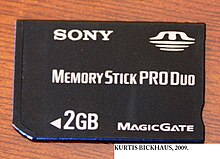
A Sony Memory Stick PRO Duo (2 GB)
The Retentivity Stick PRO Duo (MSPD) rapidly replaced the Retention Stick Duo due to the Duo's size limitation of 128 MB and slow transfer speed. Memory Stick PRO Duos are available in however variants every bit the larger Memory Stick PRO, with and without High Speed mode, and with and without MagicGate support.
Sony has released different versions of Memory Stick PRO Duo. A Memory Stick PRO Duo with MagicGate was released every bit a 512 MB stick.[ citation needed ] Additionally, a xvi GB version on March 2008 and some other a 32 GB version on Baronial 21, 2009.[28] In 2009, Sony and SanDisk as well announced the articulation development of an expanded Retentiveness Stick PRO format tentatively named "Memory Stick PRO Format for Extended High Capacity".[29] Sony has since finalized the format and released its specification nether the new name, Retentivity Stick XC (encounter beneath).[30]
Memory Stick PRO-HG Duo [edit]
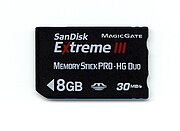
On Dec 11, 2006, Sony, together with SanDisk, announced the Retention Stick PRO-HG Duo. While merely series and iv-scrap parallel interfaces are supported in the Memory Stick PRO format, an 8-bit parallel interface was added to the Memory Stick PRO-HG format. Also, the maximum interface clock frequency was increased from 40 MHz to 60 MHz. With these enhancements, a theoretical transfer charge per unit of 480 Mbit/due south (60 MB/due south) is accomplished, which is iii times faster than the Memory Stick PRO format.
Retentiveness Stick Micro (M2) [edit]

In a joint venture with SanDisk, Sony released a new Memory Stick format on February 6, 2006. The Memory Stick Micro (M2) measures 15 × 12.5 × one.2 mm (roughly one-quarter the size of the Duo) with 64 MB, 128 MB, 256 MB, 512 MB, 1 GB, 2 GB, 4 GB, 8 GB, and 16 GB capacities available. The format has a theoretical limit of 32 GB and maximum transfer speed of 160 Mbit/s. However, as with the PRO Duo format, it has been expanded through the Xc serial as Memory Stick 90 Micro and Memory Stick 90-HG Micro, both with the theoretical maximum chapters of 2 TB.[30] [31]
The M2 comes with an adapter, much like the Duo Sticks, to ensure physical compatibility with Memory Stick PRO devices. However, not all devices with a PRO slot are uniform with the M2/Adapter combination, every bit the firmware of older devices don't support the higher capacity of some M2 cards. One example is certain Sony CLIÉ PDAs which don't support cards larger than 2 GB.[32]
Sony announced on June one, 2009, that M2 back up in Sony Ericsson phones would exist dropped in favor of microSD.[33]
The Sony DSC-RX0 Mark Ii made a revived usage of M2 slots.
Memory Stick Ninety [edit]
On January 7, 2009, SanDisk and Sony announced the Memory Stick 90 format (tentatively named "Memory Stick Format Series for Extended Loftier Capacity" at the time).[34] [35] The Memory Stick 90 has a maximum theoretical two TB capacity, 64 times larger than that of the Retentiveness Stick PRO Duo which is express to 32 GB. 90 series has the same form factors equally PRO serial, and supports MagicGate content protection applied science every bit well equally Admission Command function every bit PRO series does. In line with the rest of the industry, the XC series uses the newer exFAT file system due to size and formatting limitations of Fat/FAT16/FAT32 filesystems used in the PRO serial.[36] [37] A maximum transfer speed of 480 Mbit/s (60 Mbyte/s) is achieved through viii-fleck parallel data transfer.[38] No Memory Stick XC cards were released to the marketplace, likely due to domination of SD cards; its equivalent hither is named SDXC and eventually became more successful than whatsoever other exFAT-based memory card format.
Retentivity Stick PRO-HG Duo HX [edit]
Sony announced the release of the Memory Stick PRO-HG Duo HX on May 17, 2011, which was considered the fastest card ever fabricated by the manufacturer. It measures 20 × 31 × 1.6 mm, with viii GB, xvi GB, or 32 GB versions bachelor. Likewise, the format offers a maximum transfer speed of 50 MB/south.[39]
Mark two certification [edit]
Equally of early 2008, Mark 2-certified versions of the Memory Stick PRO Duo became available. The Marker 2 designation indicates the Memory Stick is suitable for use with AVCHD recording products or other faster Memory Stick enabled devices by providing appropriate minimum write functioning.[40]
See likewise [edit]
- CompactFlash Carte
- Comparison of retentivity cards
- Format war
- MultiMediaCard
- SD Card
- SmartMedia Card
- SxS
- xD Motion-picture show Carte
References [edit]
- ^ "Sony Global – Press Release – Sony Announces 'Retention Stick' Recordable IC Memory Card Products New Format Supports Recording and Playback of Sound/Video Content". Sony.net (Press release). Retrieved November xiii, 2011.
- ^ "The worst storage mediums of all time - Page 3 of four - ExtremeTech". extremetech.com. May 15, 2014.
- ^ "The Outset of the End of Memory Stick? Hope Then!". technologizer.com. January six, 2010.
- ^ In this article the unit of measurement symbol 'MB' is used to mean 1000^2 bytes (1 megabyte)
- ^ "Sony To License Memory Stick to 6 Firms". dpreview.com.
- ^ a b "Archived copy". www.simmtester.com. Archived from the original on July 17, 2001. Retrieved January 25, 2022.
{{cite web}}: CS1 maint: archived copy as title (link) - ^ Taub, Eric A. (Feb two, 2004). "Applied science; Retention Evolution: Survival of the Smallest". The New York Times.
- ^ "Behind the smiles at Sony". The Economist. March ten, 2005. Retrieved December 29, 2021.
- ^ "Sony.com". News.sel.sony.com. Jan 6, 2010. Retrieved November 13, 2011.
- ^ "Sony.com". News.sel.sony.com. January 6, 2010. Retrieved Nov 13, 2011.
- ^ "Sony.com". News.sel.sony.com. Jan 6, 2010. Retrieved November 13, 2011.
- ^ "Sony.com". News.sel.sony.com. January half dozen, 2010. Retrieved November 13, 2011.
- ^ "Sony.com". News.sel.sony.com. January 6, 2010. Retrieved November thirteen, 2011.
- ^ "Sony.com". News.sel.sony.com. January 6, 2010. Retrieved November 13, 2011.
- ^ Taub, Eric A. (Jan 7, 2010). "Sony's Memory Stick: Bowing to Reality". The New York Times . Retrieved May 12, 2010.
- ^ Velocity. "Forbes.com". Forbes . Retrieved November 13, 2011.
- ^ "FT.com". Blogs.ft.com. January vii, 2010. Retrieved November 13, 2011.
- ^ "Endgadget.com". Engadget.com. January half-dozen, 2010. Retrieved Nov 13, 2011.
- ^ "IEEE.org". Spectrum.ieee.org. Jan seven, 2010. Retrieved November 13, 2011.
- ^ McCracken, Harry (January vii, 2010). "PCworld.com". PCworld.com . Retrieved Nov 13, 2011.
- ^ "APCMAG.com". APCMAG.com . Retrieved November 13, 2011.
- ^ "Sony introduces the a7R 4 with 61 Megapixel full-frame sensor". Digital Photography Review. July 16, 2019. Retrieved July 16, 2019.
- ^ "CBS News, 48 Hours – AIBO, The Digital Wonder Domestic dog: Sony Spends Millions On Robotic Canine". Cbsnews.com. February 11, 2009. Retrieved November 13, 2011.
- ^ "Sony Memory Stick Pro and Select". dpreview.com.
- ^ "Sony.cyberspace". Sony.net . Retrieved November xiii, 2011.
- ^ In this commodity the unit symbol 'GB' is used to mean g^3 bytes (i gigabyte)
- ^ "Sony Compatibility Chart - Digital Still Camera". Sony-asia.com . Retrieved April 5, 2021.
- ^ "Crunchgear.com". Crunchgear.com. August 21, 2009. Retrieved Nov xiii, 2011.
- ^ "SanDisk, Sony to Expand Retentiveness Stick PRO, Memory Stick Micro Formats". Nikkei Business organization Publications. January 8, 2009. Retrieved January 5, 2010.
- ^ a b MacManus, Christopher (Baronial v, 2009). "Sony Finalizes Backwards Compatible Memory Stick XC With 2TB Maximum Capacity". Sonyinsider.com . Retrieved January 5, 2010.
- ^ In this article the unit symbol 'TB' is used to mean one thousand^4 bytes (i terabyte)
- ^ "Sony Compatibility Chart – Clie Handhelds". Sony-asia.com . Retrieved November 13, 2011.
- ^ "Trusted Review – Sony Ericsson Dropping Memory Stick Micro". Trustedreviews.com . Retrieved November xiii, 2011.
- ^ "Sandisk and Sony to expand "Retentivity stick pro" and "Memory stick micro" formats". SanDisk. January 7, 2009. Retrieved August 12, 2009.
- ^ Christopher MacManus. "Sonyinsider.com". Sonyinsider.com . Retrieved Nov 13, 2011.
- ^ "Windows FAT32 Formatting". Microsoft. Retrieved June 28, 2012.
- ^ "SanDisk exFAT KB". Kb.sandisk.com . Retrieved June 28, 2012.
- ^ "Oss-formats.org". Oss-formats.org . Retrieved Nov 13, 2011.
- ^ "Sony Great britain - Press Middle". Presscentre.sony.co.united kingdom of great britain and northern ireland . Retrieved December 29, 2021.
- ^ "Sony's new 16GB Retentivity Stick Pro Duo media [...] Mark2 Certification". News.sel.sony.com. January 6, 2008. Retrieved Nov xiii, 2011.
External links [edit]
- Sony's official 1 Stop Site for Formats, with some specifications of the electrical interface.
- Retention Stick products at Sony Singapore.
- SanDisk and Sony develop "Memory Stick Micro" (M2) format – SanDisk/Sony press release, September 30, 2005.
- SanDisk and Sony denote "Retention Stick Pro-HG" (HG) format – December ane, 2006.
- Complete Memory Stick® Media Compatibility Data for Sony® Digital Cameras Sony eSupport July 2011.
Source: https://en.wikipedia.org/wiki/Memory_Stick

Post a Comment for "How to Upload a Sony Memory Stick Duo How to Upload Photos From Sony Memory Stick Pro Duo to My Asus"